
Many owners assume that “e-invoicing” means a new duty to send structured invoices to their customers. Between businesses, e-invoicing is still voluntary and PDF invoices remain valid. What does apply to VAT payers is monthly reporting through i.SAF, and that is the part that needs clean data.
What is mandatory today
| Situation | Rule |
|---|---|
| Invoices to public bodies (B2G) | Must go through SABIS (portal, API or Peppol), mandatory since 1 July 2017. SABIS is the only accepted system. |
| Invoices between businesses, or to consumers | No e-invoicing mandate. Electronic is voluntary; paper and electronic invoices are equally valid. |
| VAT payers | Monthly i.SAF reporting of issued and received invoices, in force since October 2016, due by the 20th of the following month. |
| Companies that are not VAT payers | No invoice reporting through i.SAF. |
| Goods transport documents | Reported separately through i.VAZ. |
What is coming
No law requiring e-invoicing between businesses has been adopted. A government target of 1 January 2028 has been reported, while other sources point to the EU ViDA date of July 2030. The EU Council formally adopted the ViDA package on 11 March 2025. Treat any B2B deadline as unconfirmed until it is in law.
How invoicing works in FiscFort LT
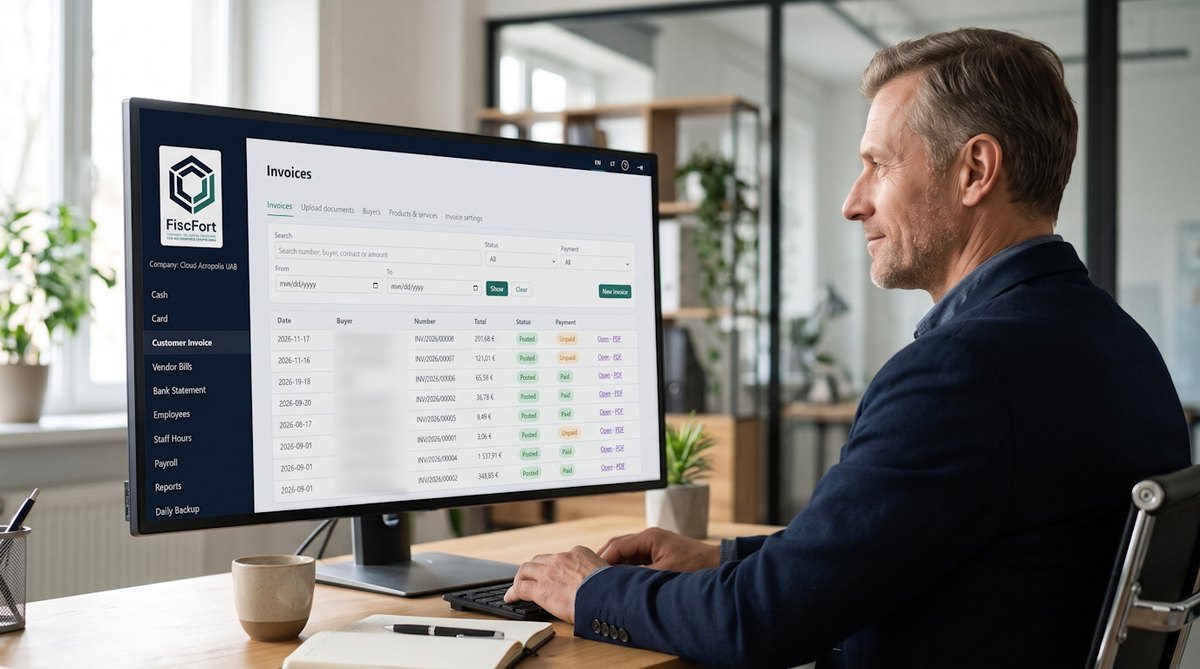
Customers create their own sales invoices in the portal, and they are booked straight into their accounts.
- Set up once. Company details, bank account, logo and PDF design. A company counts as a VAT payer only if it has a VAT code, so non-payers get invoices without VAT lines.
- Buyers that remember. Each buyer keeps its invoice language (Lithuanian or English), payment terms, VAT treatment and contract number.
- Products and services with default prices and a suggested VAT rate.
- Discounts per line, or as a separate explained discount line.
- Four PDF designs: Modern, Classic, Compact and Brand.
- Recurring invoices (weekly, monthly, quarterly, yearly). The system creates the next draft and a person confirms it. Nothing is issued behind your back.
- Duplicate an earlier invoice, adjust it, confirm it.
- Attachments: up to 10 supporting files per invoice, 5 MB each.
All sales invoices, whether created in the portal or uploaded as documents, appear in one searchable list with status and payment filters. Payment status updates when the matching bank transaction is reconciled.
From invoice to i.SAF
For VAT payers, the same data is used to prepare the monthly i.SAF file, and the declaration is prepared for your accountant to check and file. Companies without a VAT code cannot generate i.SAF, because they have no obligation to file it.
What FiscFort does not do
- It does not send e-invoices to SABIS or over Peppol. Invoices are issued as PDFs.
- It does not handle i.VAZ transport documents.
- It does not file anything on its own. A person reviews every filing.
What to do now
Check whether you invoice public bodies
If you do, those invoices must go through SABIS.
Confirm your VAT status
A VAT code decides whether you report through i.SAF and whether invoices carry VAT lines.
Set up the seller and your buyers once
Enter your company details, bank account and logo in the portal, then add your buyers and products.
Issue invoices and review the i.SAF with your accountant
Create invoices in the portal during the month, and review the prepared i.SAF before the 20th.
Sources
- European Commission: eInvoicing in Lithuania
- VMI: Which VAT invoices must be submitted in i.SAF (in Lithuanian)
- Recommand: Peppol e-invoicing in Lithuania
- Finbite: Are e-invoices mandatory for all Lithuanian companies? (in Lithuanian)
- Forvis Mazars: Lithuania, VAT in the Digital Age (ViDA)
Rules checked on 20 November 2026. Laws and guidance change; confirm the current wording with VMI before relying on a date or obligation.
Want to try it? Register and order online in a few minutes, or see the invoicing section on the SaaS and Book Keeping Lithuania pages.